
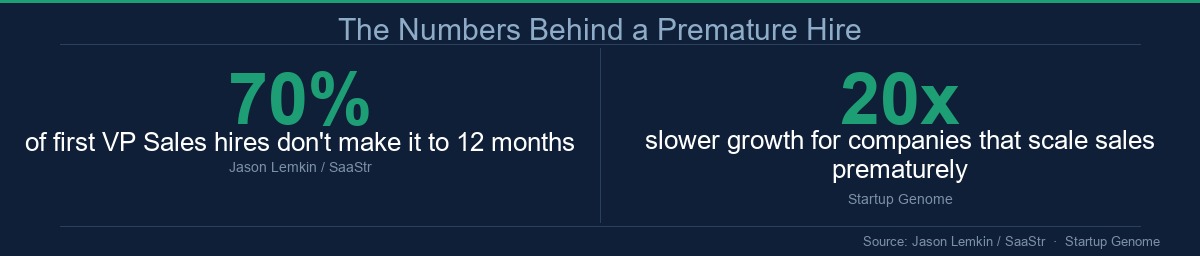
Seven out of ten first VP Sales hires at SaaS companies may not survive twelve months in the role.[1] That figure tends to land as a talent problem. The wrong person. Bad culture fit. Unrealistic targets.
In my experience, the hire is rarely the problem. The timing is.
Now apply that to a B2B SaaS company making its first international move — entering a market where established global competitors already have relationships, brand recognition, and distribution. The playing field is more expensive and more crowded than anything most founders have encountered at home. A value proposition that resonated locally now needs to compete against players who have been in that market for years. The conditions that make a first sales hire difficult in any context become considerably harder. And the consequences of getting it wrong — in wasted salary, burned leads, and lost months — are ones that early-stage companies can rarely afford.
The Problem Is Not the Person
When a first international sales hire fails, the post-mortem usually focuses on the individual. They didn’t work hard enough. They came from too large a company. They didn’t understand the product deeply enough.
These are real problems, but they are often symptoms of something more structural: the hire was brought in before the company had done enough direct selling to know what a good outcome looks like in that market.
The concept of the “MVP/ICP handshake” captures this well — the point at which your Minimum Viable Product clearly solves a defined set of problems for a clearly defined Ideal Customer Profile.[2] Hiring before that handshake has happened almost guarantees failure, not because the salesperson is incompetent, but because there is nothing stable for them to execute against. They arrive to find an undefined buyer, an untested pitch, and a founder who cannot yet tell them what winning looks like — because the founder hasn’t won enough times themselves to know.
The Case for Selling It Yourself First
Startups that scale prematurely — including by hiring in sales and marketing before achieving genuine customer adoption — grow significantly more slowly than those that don’t.[3] The data on this is consistent. So is the pattern I see in practice.
The case for founder-led international sales is not just about cost control. It is about what you learn that no hired salesperson can learn for you.
When you sell yourself into a new market, you discover which parts of your pitch land and which fall flat. You find out whether your assumed buyer is actually the economic buyer. You learn how long the sales cycle really is — not the optimistic version in your financial model. You get the objections directly, unfiltered, rather than summarised in a CRM note three days later.
This is not a comfortable process. For Israeli founders in particular, the contrast can be jarring. The domestic market is small and familiar; relationships move fast; deals often close on trust built quickly. International markets — particularly in Europe and North America — tend to move differently. Procurement processes are longer. Risk aversion is higher. Founders who expect the sales motion to feel similar to what worked at home will likely find the next few months harder than expected.
Those months, done properly, are invaluable. They are the raw material from which a repeatable GTM motion is eventually built. You can read more about why international expansion is structurally harder than most Israeli founders expect. The learning phase cannot be outsourced.
What Needs to Exist Before You Hire
Before a first international sales hire is likely to succeed, you need: a validated Ideal Customer Profile (ICP) specific to the target market — not carried over from home and relabelled; a value proposition tested with real buyers in that market and refined on the basis of their actual objections; a rough but real sense of a repeatable sales motion — what triggers a conversation, what moves a deal forward, what causes it to stall; and a realistic picture of the sales cycle length and the typical buying committee.
Most companies that hire too early have one or two of these. Very few have all of them. And without all of them, the new hire is not executing a sales process — they are still discovering one. That discovery work costs considerably more when it is done by a full-time executive on a senior salary than when it is done by the founder, ideally with experienced support alongside them.
The Role of Outside Expertise in Bridging the Gap
There is a stage between “founder selling alone” and “first full-time international hire” that many companies skip, and probably shouldn’t.
What that stage requires is not a sales executor. It requires someone who can sit across all the elements that need to be in place before a hire makes sense — and make sure they actually are. That means aligning the ICP with the realities of the target market; sharpening the USP for a competitive international environment; sense-checking pricing against local expectations; defining the right product scope for early traction; identifying the right marketing activities and sales channels; and ultimately building the playbook that your future hire will need to execute. The goal is to ensure that when a senior hire joins, they have a real foundation to work from — not gaps they need to fill themselves.
Stripe’s early approach illustrates the underlying logic well. They hired former consultants as their first account executives — not for their sales experience, but because they could learn fast, listen carefully to customers, and help build the playbook rather than simply execute one that didn’t yet exist.[4] In a new market with genuine uncertainty, the ability to learn and adapt is more valuable than a contact list.
The question worth asking before you hire is not “can this person sell?” — it is “is there enough here for them to sell, and is the infrastructure solid enough for them to do it well?” Find out more about how Beam Global approaches international go-to-market strategy for Israeli B2B companies.
Who to Hire When You Are Ready
When the GTM foundation is in place, the instinct to hire an experienced industry veteran — someone who has sold in that market for years — is understandable but often wrong. Veterans are execution machines. They are good at running a playbook, not building one. Drop them into an early-stage environment where the ICP is still being refined and the messaging is still evolving, and they tend to struggle.
The better hire at this stage is a smart generalist: curious, fast-learning, comfortable with ambiguity, and genuinely interested in understanding customers rather than just closing them. Someone who treats a lost deal as data rather than a disappointment. That profile is harder to find and sometimes harder to justify on paper — but in practice, it is the one that tends to work.
In a foreign market, where everything from buyer behaviour to decision-making culture may be unfamiliar, that matters even more.
The Real Cost of Getting This Wrong
When salespeople underperform, you waste time and money. But in an international market where your brand is unknown and your prospect universe is finite, the more lasting damage is the leads you burn. A potential customer who has a poor or confusing experience with your company in year one is unlikely to give you a second opportunity in year two.
The cost of a premature international sales hire is rarely visible on a spreadsheet. It shows up in the pipeline that never materialised, the relationships that soured before they had a chance to develop, and the 12–18 months added to a company’s international timeline.
The high failure rate for first sales hires is a statistic about timing, not talent. The fix is not to hire more carefully — though that matters too. It is to invest seriously in understanding the market, and building the infrastructure to support a hire, before you ask someone else to sell it for you.
If you are working through where your company sits on that readiness curve, I am happy to have that conversation.
[1] Amy Volas, Avenue Talent Partners, citing Jason Lemkin / SaaStr: https://www.linkedin.com/pulse/right-time-hire-vp-sales-your-startup-amy-volas
[2] Joe DiMento, Bain Capital Ventures, “The MVP/ICP Handshake,” September 2024: https://baincapitalventures.com/insight/the-mvp-icp-handshake-how-to-move-from-founder-led-to-ae-led-sales/
[3] Startup Genome / Blackbox research, via TechCrunch, September 2011: https://techcrunch.com/2011/09/01/a-deeper-look-at-blackboxs-data-on-startup-failure-and-its-top-cause-premature-scaling-infographic
[4] Scaling With Soul, “Sell It Yourself, Dammit,” May 2025: https://scalingwithsoul.substack.com/p/sell-it-yourself-dammit-the-case



3 Responses
Hi,
This sounds relevant for a standard software B2B SaaS company.
what is your input in 2 cases:
1) The solution contains also hardware.
2) The end customer does not speak English (French, Spanish, Hungarian) and the SaaS startup does not speak that language.
Great questions – both cases come up more often than you’d think.
On hardware + software:
Good point. I actually wrote some time ago about the The Paradise of Software Companies: https://beamglobal.co.il/the-paradise-of-software-companies/ .
The core principle doesn’t change – validate the ICP and build the playbook before hiring. But hardware adds logistics, local compliance, warranty and support infrastructure, and longer procurement cycles. This makes the founder-selling phase even more important, because these aren’t just sales questions – they’re operational ones. You need to understand the full customer journey in that market before you can hand it to a salesperson.
A hardware component also often means the first hire needs a more technical profile, or a pre-sales engineer alongside them. And there’s another challenge worth flagging: experienced hardware salespeople – sometimes called “box movers” – can be difficult to retrain toward solution selling. If your product is a hardware-software combination, you need someone who already thinks in terms of business outcomes and customer problems, not just specs and units. That shift is harder than it sounds, and hiring the wrong profile here is a common and expensive mistake.
On language:
The economic buyer in most B2B contexts speaks English well enough for the sales process, even in France, Spain, or Hungary. The challenge tends to appear more at end-user and support level, not at the buying level.
A local partner – reseller, VAR, or distributor – is often the right answer, not a direct hire. A partner who already has the language, relationships, and market credibility can close what a direct hire from outside cannot. This is especially true for France and Hungary where language and culture are genuine barriers.
If you do hire directly, the hire must be a native or near-native speaker. A strong English-speaking salesperson will struggle in a French enterprise account if they can’t conduct the relationship in French.
In both cases the validation phase before hiring becomes longer and more complex – not shorter. These are exactly the conditions where getting the GTM infrastructure right before committing to a senior hire matters most.
Thank you Ori for the answer.
I think that a local partner is also relevant to the first case: software + hardware.