
At some point in every Israeli B2B software company’s journey, the founder – who is usually still running most of the international sales effort personally – faces a version of the same question: which international market do we actually focus on? They have a real product, paying customers, and a website that’s clearly aimed at the global market. What they don’t have is a systematic answer to which geography deserves their next six months.
In my experience, that decision gets made in one of three ways. None of them are good.
The three common mistakes
The first is the American reflex. The US is large, English-speaking, and full of companies that look like good potential customers. For a 30-person Israeli SaaS company with $1.2 million in ARR and no US presence, it also means competing in the world’s most saturated B2B software market against vendors who have headquarters there, local references, established partner networks, and sales teams that know the buyers personally. The US holds the largest share of the global B2B SaaS market and is characterised by a high concentration of major vendors and a culture of early technology adoption (Verified Market Research, 2025) – which is another way of saying that buyers have seen every pitch, have extensive benchmarking tools, and will move slowly with a foreign company that has no local footprint and no local references.
The second mistake is territory by personal connection. Someone on the founding team has a personal connection in Germany, or a cousin in Australia, or a former colleague who now lives in Amsterdam. Connections matter in international sales – they genuinely do – but when the connection becomes the strategy, things go wrong. I’ve watched companies spend a year in a market they entered because of a relationship, only to discover that their primary competitor had its European headquarters in that exact city. A competitive mapping exercise that takes a day would have surfaced that. The connection didn’t.
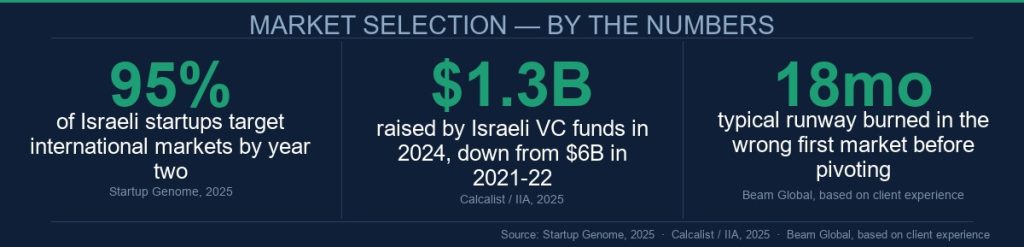
The third mistake is the one that’s hardest to see. It’s picking the same markets that well-known Israeli companies entered, on the assumption that if it worked for them, it will work for you. What gets ignored is the enormous difference in conditions. In the boom years of 2021-2022, around 60 local funds raised about $6 billion annually in Israel. In 2024, only 22 funds raised just $1.3 billion (Calcalist, 2025). The companies your peers are pointing to as inspiration often entered their first markets with $15-20 million in runway, a dedicated VP Sales already hired, and the ability to absorb 18 months of negative results in a new geography. That is a fundamentally different position than a founder-led company with a small team trying to close its first five international accounts.
What market selection actually requires
A few years ago I published a structured framework for territory selection that I use with clients – you can download it here. The core logic is worth restating: the goal is not to identify the most prestigious market, or the largest one, or the one that sounds most ambitious. The goal is to identify the market where your company has the highest probability of success given your current product, resources, competitive position, and go-to-market motion.
Territory selection also determines which partner ecosystems you can access – something most founders discover only after they’ve already signed a channel agreement. That topic deserves its own treatment, and I’ll return to it in a future piece.
The filtering process I work through with clients involves three questions that go beyond market size.
Where is your competitive density actually concentrated?
Most founders map competitors by product category – cybersecurity, ITSM, supply chain software. What matters more for territory selection is where those competitors’ headquarters and primary sales operations are based. A dominant vendor’s home market is almost never the right place to start. You’ll compete on their terms, on their reference base, against their existing relationships with the exact partners and buyers you need. If your competitive mapping turns up geographies where the incumbents are weak or declining, that asymmetry is worth far more than raw market size.
Where do you already have organic signals?
Inbound website inquiries from a specific country. Interest at a trade show from buyers in a particular region. An existing customer who bought your product and uses it across their European operations. These are not anecdotes – they are early market data that most founders systematically underweight because it feels less rigorous than a formal market study. According to Startup Genome’s Global Startup Ecosystem Report, 95% of Israeli startups target international markets by their second year (Startup Genome, 2025). The ones that succeed fastest are usually the ones that followed the organic signals rather than the ambition.
What can you actually execute with the resources you have?
This question requires honesty. If your team is small and your budget is limited, then a market that structurally requires trade show presence at major annual events, domestic travel across a continent-sized geography, or immediate investment in a local entity is probably not your first market – regardless of how attractive it looks in a market research report. The right first market is one where you can run a credible go-to-market motion with the team and budget you actually have today. Not the team you plan to build. Not the budget you’re hoping to raise.
The cost of getting this wrong
The gap between “Israel builds great technology” and “Israel’s companies win in global markets” is real, structural, and widely underestimated. High-tech exports reached record levels in 2025, led by Google’s $32 billion acquisition of Wiz – the largest tech acquisition in Israeli history. Those headline numbers are real. They also describe the exits of a previous generation of companies, built in different conditions. They say nothing about the hundreds of B2B SaaS companies currently trying to close their first international deals with limited budgets, no local presence, and a founder carrying most of the GTM weight personally – a pattern I wrote about in detail here.
Market selection done well doesn’t solve all of those problems. But market selection done badly compounds every one of them – by pointing scarce resources at the wrong geography, the wrong competitive battle, and the wrong timing.
The decision deserves the same rigour you brought to building the product.
If you’re currently working through a market selection or territory prioritisation decision, I’m happy to map it with you. You can reach me here.
Sources
1. Verified Market Research, B2B SaaS Market Report, September 2025 – US holds the largest share of the global B2B SaaS market
2. Calcalist / IIA, September 2025 – Israeli VC fund raises fell from ~$6B annually (2021-22) to $1.3B in 2024
3. Startup Genome, Global Startup Ecosystem Report, 2025 – 95% of Israeli startups target international markets by their second year
4. Calcalist, June 2026 – High-tech exports reached $85 billion in 2025, 58% of total Israeli exports