
One of the companies I work with is an established Israeli compliance-software vendor. It has a broad portfolio of products and services that covers most of what its customers need. As with most portfolios, some of those products are clearly stronger than others. When we started planning its international expansion, we faced the question almost every company faces at this stage. Should it go abroad as a one-stop shop offering the full set, or lead with the one product that has a real competitive advantage?
In software buying, this is usually framed as suite versus best-of-breed. A suite, often called a platform or an all-in-one solution, bundles several related products (and sometimes services) from one vendor under one contract. Best-of-breed means choosing the strongest specialist product for each need. In my experience, for a new player entering a foreign market, the strategic choice is often between a broad set of products that are good enough and a narrow one with a clear edge.
The case for the suite is real
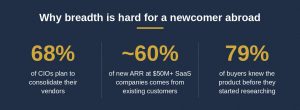
I don’t want to dismiss the suite model, because buyers are moving towards it. Australian research firm ADAPT’s 2025 CIO research found that 68% of CIOs plan to consolidate their vendor engagements, with those pursuing consolidation targeting around a 20% reduction in supplier count. Fewer vendors means fewer contracts, fewer integrations, fewer security reviews and one accountable party when something breaks. A vendor that can meet every need in a category is solving a problem the buyer already has, and one pitch covers more of the buyer’s budget.
Suites also benefit from a commercial engine that is easy to underestimate: the installed base. US venture firm High Alpha’s 2025 benchmarks show that SaaS companies above $50 million ARR now generate roughly 60% of their new ARR from existing customers. Much of an established suite vendor’s growth comes from selling more to people who already trust it.
Why going broad is harder for a newcomer
A new player’s suite usually has to fight on two fronts at once. Against established suites, it competes with vendors whose customers already trust them and who can cross-sell into an installed base the newcomer doesn’t have. Against specialists, each of its products is measured against one built to do only that job. Good enough rarely wins that comparison.
Buyer behaviour makes this harder still. In TrustRadius’s 2026 survey of 1,862 technology buyers, 79% had already heard of the product before they started researching. A buyer who wants fewer vendors is probably looking to consolidate onto someone they already know. Handing several needs to an unfamiliar vendor with a set of adequate products is a big risk to ask a buyer to take.
The specialist route, and its price of entry
The alternative is to lead with one product built around a differentiated capability. That is a feature or approach that gives it a real competitive advantage and can be turned into a unique selling proposition. Best-of-breed can win a foothold where a newcomer’s suite can’t, but I don’t think it’s an easy option either. A buyer takes a chance on an unknown narrow player only when two conditions hold. The pain has to be acute enough to justify the risk, and the product’s advantage has to be clear and provable.
That second condition is harder than it sounds. When we mapped the competitive landscape for the company above, several features we had assumed were unique turned out to exist at competitors. Only a small number of claims survived the scrutiny. A specialist without a defensible advantage is simply a small vendor with a narrow catalogue.
There is also a third hurdle. The same ADAPT research points to a growing preference for vendors that offer integrated solutions and reduce complexity. A specialist product has to fit cleanly into the buyer’s core systems, because every standalone tool is one more integration, one more login and one more thing for IT to maintain. Ready-made integrations with the platforms buyers already run are probably part of the price of entry, not a later nice-to-have.
Proof also matters more for an unknown than for a known brand. The same TrustRadius survey found that 74% of buyers use reviews to inform their purchase decisions, and 53% spoke to a peer during their buying process. A specialist entering a new market needs local evidence early, even if that starts with two or three reference customers.
Going narrow means choosing a segment
A differentiated capability probably matters most to buyers who feel the specific pain it addresses. In my experience, that makes the specialist route a segmentation decision as much as a product decision. The question shifts from “who could use this?” to “which segment feels this pain most acutely right now?” Within that segment, it also matters whether the people who feel the pain have the budget and authority to buy, without a long approval chain across many departments.
For a small company, this usually means choosing one entry strategy and selecting territories to fit it. Once you know which segment and which pain you are leading with, the right territories are the ones where that segment is concentrated, reachable and under pressure to act. I’ve written separately about why market selection is not a feelings decision, and segment choice deserves the same discipline.
Going narrow also means borrowing a customer base
This is the trade-off I think founders often underestimate. An established suite vendor sells through its existing relationships. A specialist entering a new market has none there, so it has to borrow them.
That usually means two kinds of partnership. Technology partners put the product inside the workflows where the problem already lives: the platforms, marketplaces and ecosystems buyers use every day. Channel partners, such as distributors, integrators, agencies and resellers, own the buyer relationship and the trust that comes with it. Just as importantly, both types of partner can give the customer what a suite promises: a single point of contact and a one-stop shop, with your product embedded in their platform, services or wider offering. In effect, partners let a specialist compete for suite-minded buyers without building a suite. In the case above, many service providers in the category turned out to be potential business partners rather than competitors, because they didn’t offer that specific capability themselves.
Partner dependency brings its own risks. A prospective partner may also sell a competing or adjacent product, so vetting has to include a check for product overlap, not only commercial fit. And going narrow isn’t always cheaper. It moves part of the investment from product breadth into partner infrastructure: partner profiles, partner-specific messaging, enablement and co-selling mechanics. Companies that choose the specialist route without budgeting for that tend to end up with partner agreements that are signed but inactive. Building that layer starts with finding and recruiting the right channel partners in each target market.
Win a beachhead, then widen
For most new players abroad, the suite is probably a destination rather than a starting point. The more useful starting point is a beachhead: a specific combination of market, segment, pain and persona where you concentrate your resources, win, and then expand. Lead with the product that has the clearest advantage and aim it at the beachhead. Put the partners in place to reach it, and to wrap your product into the complete solution buyers want.
This is also where AI has changed the economics for small companies. Finding and working a target niche used to take months of manual research. Today, AI-assisted research can map segments precisely, check which companies match the ideal customer profile, and watch for moments that suggest a company is ready to act. I find it useful to separate two kinds of information here. Signals tell you whether a company fits: the market it sells into, its size, its systems, the obligations it faces. Triggers tell you whether the timing is right: new funding, an approaching regulatory deadline, a relevant new hire, expansion into a new region. Signals determine relevance, and triggers determine urgency. AI makes all of this far cheaper to track, so a small team can spend its limited sales capacity on the prospects most likely to buy. It doesn’t make the strategic choice for you, though. Deciding which beachhead to attack, and which advantage to lead with, remains a human judgement.
Once you have reference customers in the beachhead, your other products become cross-sell opportunities, and the one-stop-shop story becomes credible. Breadth still has a role from day one, but as a trust signal rather than the pitch. A vendor with a wider portfolio can point to depth of experience across the category, even while it leads with a single product.
Before committing either way, it’s worth asking three questions. Would your advantage hold up, and stand out, against competitors? Which segment would take a risk on you first? Which partners already own the relationships you need? In my experience, companies that answer those questions before entering a market spend far less time wondering why their pipeline there never materialised.
If you’re weighing which of your products should lead in a new market, and what partner infrastructure it would need behind it, I’m happy to think it through with you. Get in touch for a conversation.