Israel’s high-tech sector just delivered one of the most paradoxical reports in its history. According to the Israel Innovation Authority’s 2025 Annual High-Tech Report, exit values reached record levels [1] — led by Google’s $32 billion acquisition of Wiz, the largest tech acquisition in Israeli history. By any headline measure, the ecosystem is thriving.
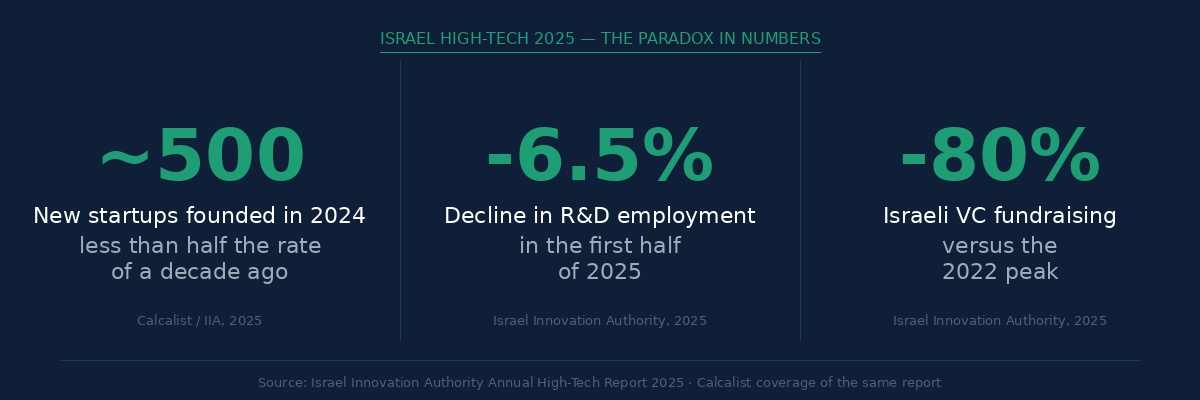
And yet: the number of new startups founded in Israel has fallen to around 500 per year — less than half the 1,000-plus founded annually a decade ago [1b]. R&D employment declined 6.5% in the first half of 2025. High-tech output has stagnated for two consecutive years at 17% of GDP. Israeli VC funds raised 80% less capital than their 2022 peak [1].
The headline numbers celebrate the exits of a previous generation of companies. They say very little about the hundreds of B2B SaaS and AI-native startups right now trying to close their first international deal — with limited budgets, no local presence abroad, and a global market that has never been more competitive.
I’ve spent over two decades helping Israeli B2B tech companies expand internationally. The gap between “Israel builds great technology” and “Israel’s companies win in global markets” is real, structural, and — in my experience — widely underestimated. Here’s what I think probably drives it.
The innovation trap
Israeli founders are world-class at building product. The country’s military tech heritage, academic excellence, and culture of engineering rigor produce genuinely differentiated software. The problem is not the technology. The problem is what happens the moment the product needs to be sold to someone in Munich, Singapore, or São Paulo who has never heard of you and has four incumbent vendors competing for the same budget.
Israel’s compact domestic market — just over 10 million people [2] — is both a constraint and an advantage. It forces companies to think globally from day one. But thinking globally and selling globally are entirely different disciplines. The first is a mindset. The second is a system. Most early-stage Israeli teams have the mindset. Very few have the system.
What “going global” actually requires
The research on international SaaS expansion is consistent on one point: a copy-and-paste approach to go-to-market rarely survives contact with a new market [3]. Localization is part of the answer — but it is a much broader challenge than most companies assume. Language is one dimension of it. Others include whether your product meets the compliance standards or data residency requirements of the target market, whether you have reference customers that local buyers recognize and trust, and whether there is a local reseller, systems integrator, or industry influencer who can vouch for you before a procurement committee ever sees your pitch deck.
A product that closes deals in Israel on the strength of a founder’s network and a sharp demo needs a fundamentally different commercial architecture to do the same in Germany, Japan, or the Gulf.
“The innovation is rarely the problem. The commercial architecture around it — the references, the channel, the market fit — almost always is.”
The concentration problem probably compounds it
The Innovation Authority’s report reveals another structural risk: three out of every five shekels raised in 2025 went into cybersecurity or enterprise software — the two areas where Israeli tech is most concentrated and global competition is most intense [1b]. For a small company trying to win international deals in either space, this means facing a market crowded with well-funded, well-branded, locally established alternatives.
Winning in that environment requires more than a good product and a LinkedIn page. It likely requires a deliberate go-to-market strategy built around the target market’s buying behaviour, competitive dynamics, and channel infrastructure — not only around what worked in the Israeli pilot.
What tends to work
Based on my work across dozens of Israeli B2B companies entering European, North American, and APAC markets, the consistent differentiator between companies that break through and those that stall is not only budget size. It is sequencing and focus.
Companies that succeed internationally tend to do three things before anything else. They define a very specific ICP for the target market — not a global average, but a buyer profile that reflects local purchasing behaviour, competitive context, and how decisions get made and who needs to approve them. They choose a channel architecture that fits the market: direct, partner-led, or marketplace-first — and commit to it properly rather than running all three simultaneously. And they ensure that someone with genuine international commercial experience is accountable for execution, not just strategy.
The challenges that typically derail international expansion are well-documented and largely avoidable — but only if you’ve seen them before. Skipping the readiness assessment, under-budgeting for the first 12 months, hiring a local salesperson before channel infrastructure exists: these are patterns I encounter repeatedly, and they each tend to add 12–18 months of lost time to a company’s international timeline.
The window is probably narrowing
The 2025 data tells a dual story. On one side: record exits, global recognition, world-class deep-tech. On the other: fewer new companies being built, tighter funding, and an ecosystem that is concentrating rather than diversifying [1]. For B2B SaaS and AI-native founders in Israel right now, the implication seems clear — the window to establish international commercial traction before funding gets tighter is not widening. The companies that invest seriously in their international go-to-market today are, in my view, the ones most likely to be celebrating exits five years from now.
The gap between building great technology and winning international customers is real. It is bridgeable. But it probably requires treating commercial expansion with the same rigour and discipline that Israeli companies apply to their engineering.
Working on your international go-to-market strategy? I help Israeli B2B SaaS and AI companies navigate exactly this gap — from market selection and channel design to first international deals. Book a free consultation.
Sources
[1] Israel Innovation Authority — Annual Status Report on Israeli High-Tech 2025 (September 2025). innovationisrael.org.il
[2] Calcalist — Israeli high-tech breaks records in 2025, but growth stalls (September 2025). calcalistech.com
[3] Israel Central Bureau of Statistics — Population data, end of 2025. timesofisrael.com